I help leaders see more clearly and make better choices about what comes next.
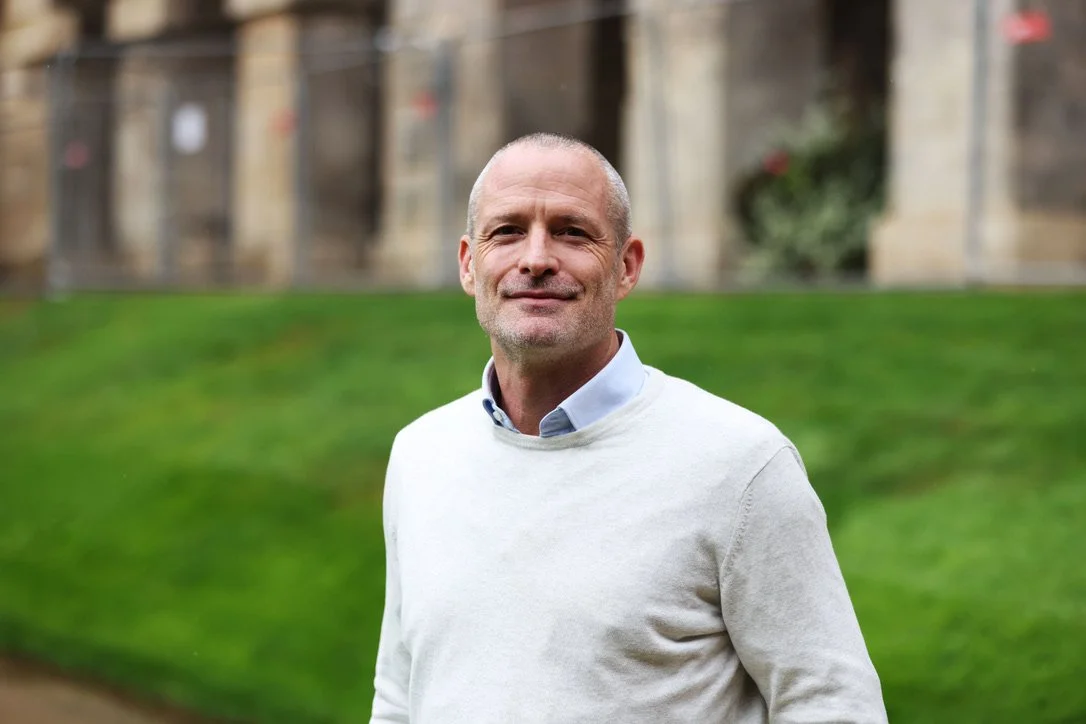
I help leaders see their business more clearly and make better choices about what comes next.
Every successful business develops a particular understanding of where its value lies, what its customers want and how it should compete.
That understanding shapes thousands of decisions. It also becomes harder to examine as the business grows around it.
I work with CEOs, boards and leadership teams when important questions about growth, direction or positioning have become difficult to answer. We examine the assumptions shaping the business, look closely at what is changing and decide where its best opportunities lie.
I call this work Strategic Sight. It draws on thirty years in global strategy and leadership roles, my work with organisations across many industries, and nearly a decade studying and teaching strategy at Oxford.
The questions that bring people to me
The work often begins with a question that has been discussed many times without being resolved.
The leadership team may be considering where the next period of growth will come from. The business may have substantial value that customers struggle to recognise. A market shift may be placing pressure on an established proposition. Several opportunities may appear credible, with no shared basis for deciding between them.
Sometimes the question sits beneath a collection of smaller problems. Marketing is underperforming, the proposition has become complicated, leadership discussions keep returning to the same disagreements, or a strategic plan contains plenty of activity without a sufficiently strong account of why the business will succeed.
I help the leaders involved step back from the immediate decisions and examine the thinking connecting them.
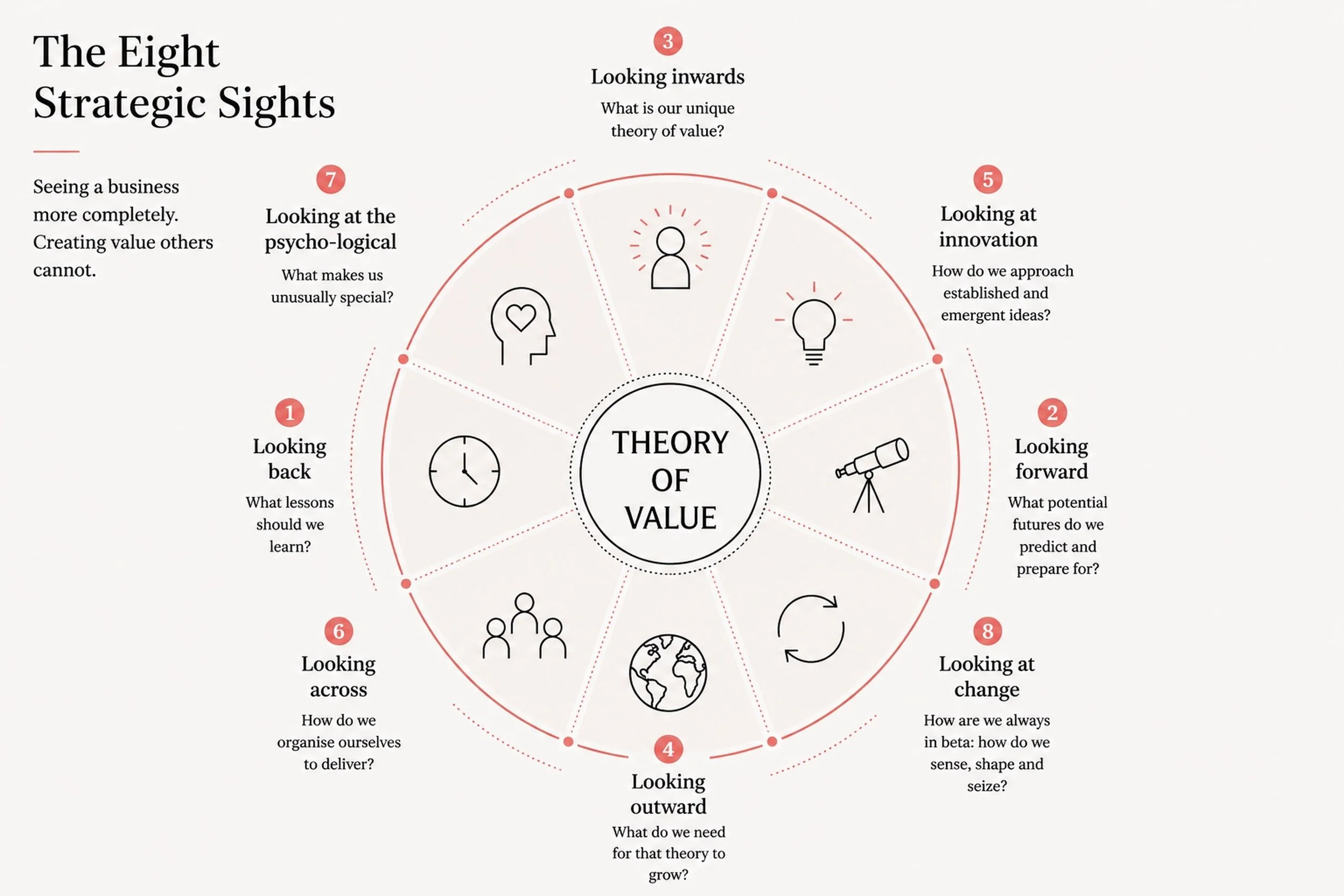
The Eight Strategic Sights.
Success gradually gives a business its own way of seeing.
Leaders develop beliefs about where value lies, how customers behave, which competitors matter and what good performance looks like. These beliefs make coordinated action possible. They influence what receives attention, what is measured and which opportunities appear credible.
Some remain useful for decades. Others gradually lose their connection with the world outside the business.
This becomes especially important when customer behaviour changes, technology alters the economics of a market, or an advantage once distinctive to the organisation becomes widely available.
Strategic Sight is the approach I use to examine the business from eight related perspectives. Each addresses a different strategic question: what has shaped the business, what is happening inside and around it, where change is taking place, how people make sense of its value and what the organisation believes about its future.
Together, they give a leadership team a fuller view of the choices in front of it.
“"Saul is a exemplar of how to combine intellectual theory with practitioner insights.”
Daniel Armanios, BT Professor of Major Programme Management, Saïd Business School, University of Oxford.
How the work usually begins
Most new relationships begin with a Strategic Sight Review.
I spend time with the people closest to the important decisions, read the material currently guiding the business and develop a view of the assumptions, tensions and possibilities that deserve attention.
The review usually includes a series of individual conversations followed by a working session with the leadership team. I then set out what I have found, the questions I believe the business needs to answer and the choices that appear most consequential.
The scope depends on the size and circumstances of the organisation. A typical review takes between two and four weeks.
It may lead to a larger strategy project, a piece of work on the proposition or an ongoing advisory relationship. In some cases, the review gives the leadership team enough to continue the work itself.
Scrap-It: creating a stronger basis for growth
Scrap-It had deep knowledge of its market and had built a successful business around it. The leadership team believed there was considerably more potential in the company and asked me to help them work out how to realise it.
I spent time learning the industry, understanding the needs of its clients and examining how the company described its work.
Together, during a facilitated workshop and then individual work afterwards, we developed a more distinctive offer and a clearer way to express the value behind it. The work gave the business a stronger position from which to sell and grow.
Revenue subsequently doubled.
“Saul fundamentally reshaped the direction of our business. He spent time to learn our industry, understand our client, and how best to position ourselves. The work he did resulted in us creating a differentiated offering, being able to articulate it, and perhaps most importantly, it doubled our revenue.
His ability to be a creative thought partner, challenging the business, and then position the companies he works with makes him a true unicorn. Thanks will never be enough for what he enabled and unlocked for us.”
Dom Perry, CEO and Founder, Scrap It, USA.














About my approach
I have spent more than thirty years working in strategy, creativity, leadership and organisational change.
During that time, I have held global C-suite roles in commercial organisations and at the United Nations, advised businesses and institutions across many industries, and worked closely with founders, boards and executive teams.
For much of the past decade, I have also studied and taught strategy at Oxford.
The combination has shaped how I work. I am interested in the quality of the ideas behind a business and in what happens when those ideas encounter commercial pressure, organisational habits and the complicated behaviour of actual people.
Clients tend to use me as a thought partner who can move between these levels: understanding the larger strategic question, seeing how it appears in the organisation and helping the people involved make decisions they can carry into practice.
Former Global Chief Strategy Officer, WPP
Former Global Chief Marketing Officer, United Nations
Associate Fellow, Strategy, Innovation and Leadership Tutor, Saïd Business School, University of Oxford
Senior Adviser and Fellowship Faculty, Centre for Democracy and Peace Building
My work with organisations
Strategy and advisory
I work with organisations on questions concerning growth, business direction, positioning, demand and leadership.
An engagement may begin with a Strategic Sight Review, develop into a larger strategy project or continue as an advisory relationship with the CEO and leadership team.
Talks and leadership sessions
I speak to boards, executive teams and company audiences about strategic assumptions, judgement, technological change and the ways in which organisations create and lose advantage.
Every session is developed around the organisation, its audience and the questions it wants to explore.
“Saul brings fresh thinking from academia, combined with the realities of leadership and organisational change from industry. A unique combination. He challenged us to think more deeply about connection, reflection, innovation and the assumptions that shape our decisions. He created an environment where people felt comfortable and at ease with exploring new perspectives.
We would highly recommend Saul to any organisation looking for a leadership facilitator with a genuine curiosity and commitment to understanding how he can support the organisation he works with.”
Beverly Copeland, Group Chief People and Culture Officer, Ulster Carpet Group.

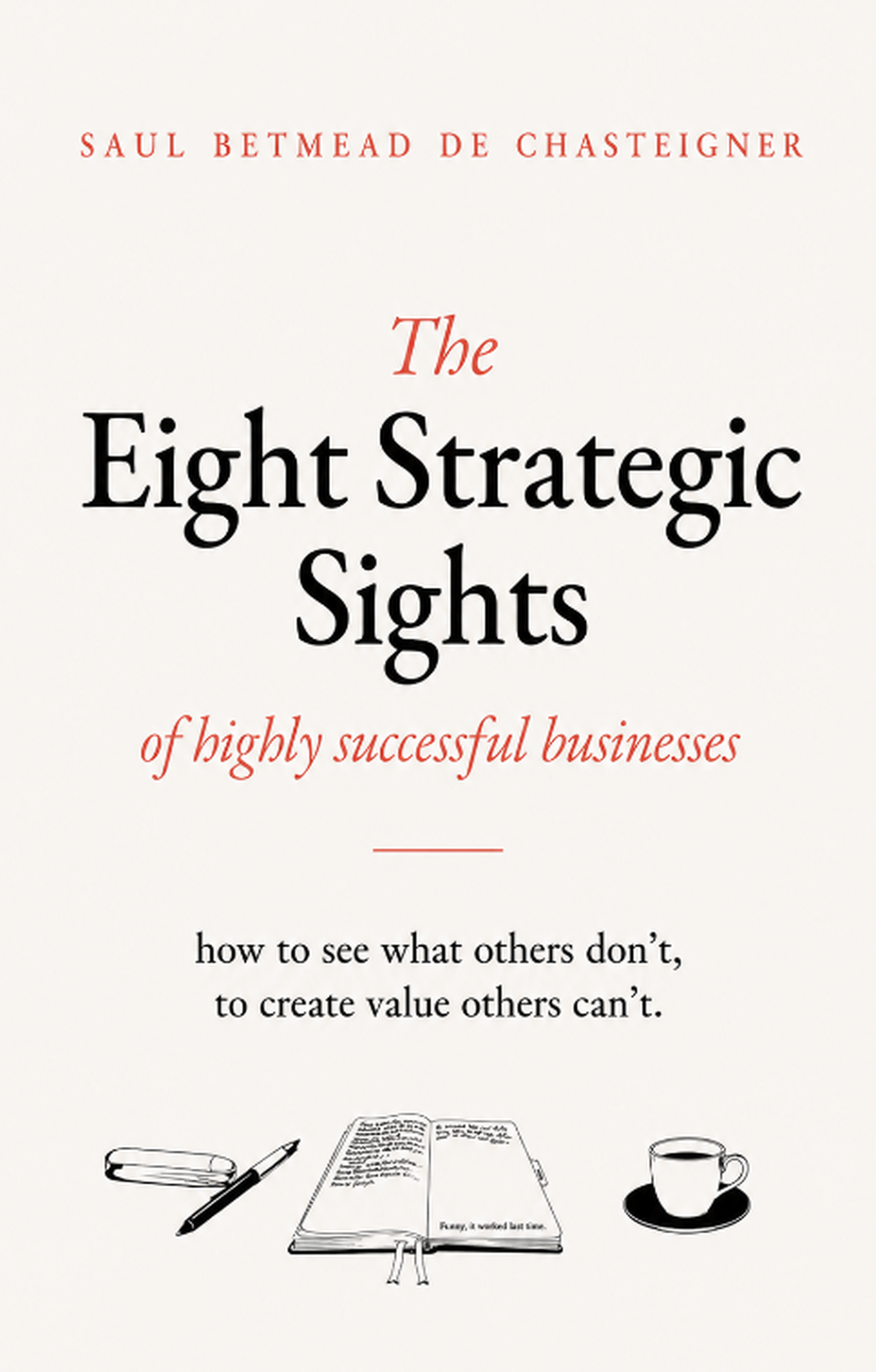
‘Funny, it worked last time.’
I write a weekly newsletter about strategy, psychology, creativity and the ways people make sense of change.
The title comes from a phrase that captures a common organisational habit: continuing to use an idea because experience has taught us to trust it, even as the circumstances around it change.
The essays vary in length and subject. Each begins with something I have noticed and follows the thought wherever it appears useful to go.
Some spontaneous, lovely things subscribers have said:
‘Your thinking is delicious!’
‘This is excellent and a much-needed perspective.’
‘An excellent article - one worth reading, putting aside and then coming back to time and time again. ‘
What question is your business trying to answer?
If you’d like to know more, send me a short note about the organisation, the question you are facing and anything that makes the timing important.
I will reply personally. If I think I can be useful, we can arrange a conversation and take it from there.